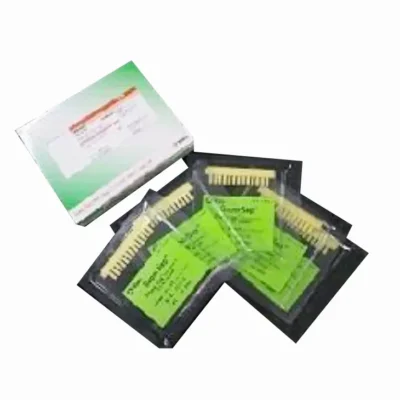


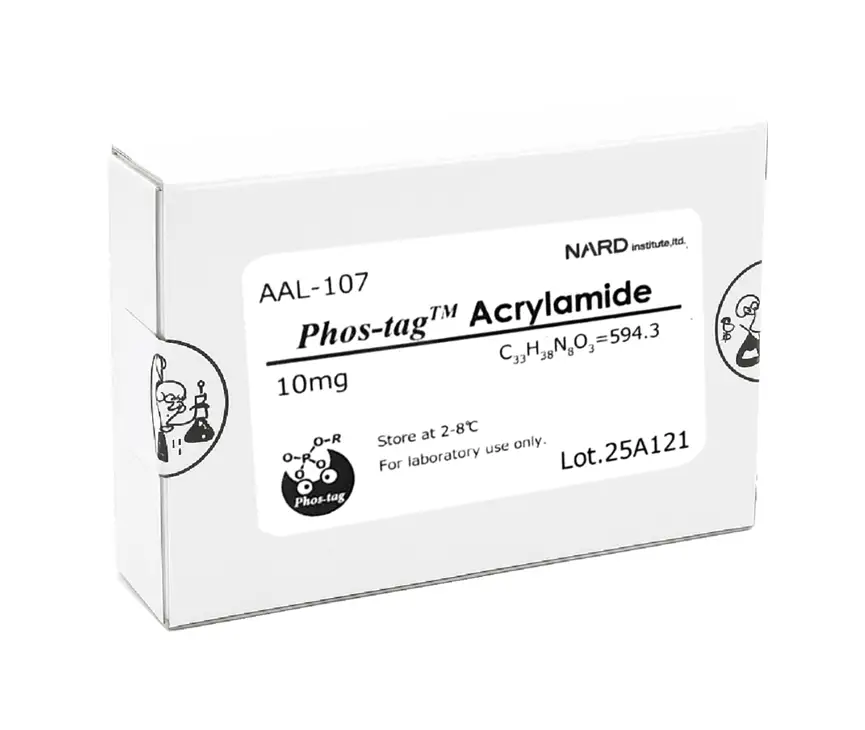
Phos-tag (TM) Acrylamide
Phos-tag™ SDS-PAGE can be performed to separate phosphorylated and non-phosphorylated proteins by mixing Phos-tag™ Acrylamide with acrylamide solution to allow for polymerization to occur.
Storage Condition : Keep at 2-10 degrees C.
Request to COA Click Here
Description
Phos-tag™ SDS-PAGE can be performed to separate phosphorylated and non-phosphorylated proteins by mixing Phos-tag™ Acrylamide with acrylamide solution to allow for polymerization to occur.
Additional information
| Catalog No. | AAL-107, AAL-107M |
|---|---|
| Pack Size | 10mg, 2mg |
| Physical State | Liquid |
- It can be used regardless of the type and position of amino acid residues.
Able to analyze unknown phosphoproteins.
Able to detect new phosphorylation sites for which anti-phospho antibodies are not commercially available. - Phosphorylated forms with different number and location of phosphorylated sites can be separated.
Able to determine the level of phosphorylation and the number of phosphorylated forms. - It can be used to detect phosphorylated and non-phosphorylated forms simultaneously.
Able to quantify each phosphorylated form.
Able to determine the presence of phosphorylation easily. - Radioisotopes and special equipment are not needed.
Experiments can be carried out easily at low costs (Only SDS-PAGE reagents and equipment are required). - After electrophoresis, WB- and MS-based analyses and 2D gel electrophoresis can be performed.
WB: Internal proteins can be analyzed.
MS: The combinations of phosphorylated sites for each phosphorylated form can be determined.
2D gel electrophoresis: Phosphorylated forms with identical isoelectric points or molecular weights can be separated.
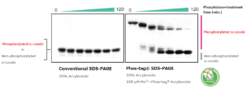
Application: Time Course of α-casein Dephosphorylation
Phos-tag™ SDS-PAGE and conventional SDS-PAGE were performed to separate samples of α-casein, which had been dephosphorylated over time (incubation period: 0-120 mins) by alkaline phosphatase.
Related products
-
-
Phos-tag (TM) Biotin BTL-111 1mM Aqueous Solution
- Select options This product has multiple variants. The options may be chosen on the product page
-
-

-
Phos-tag™ Biotin Probe
- Select options This product has multiple variants. The options may be chosen on the product page
-